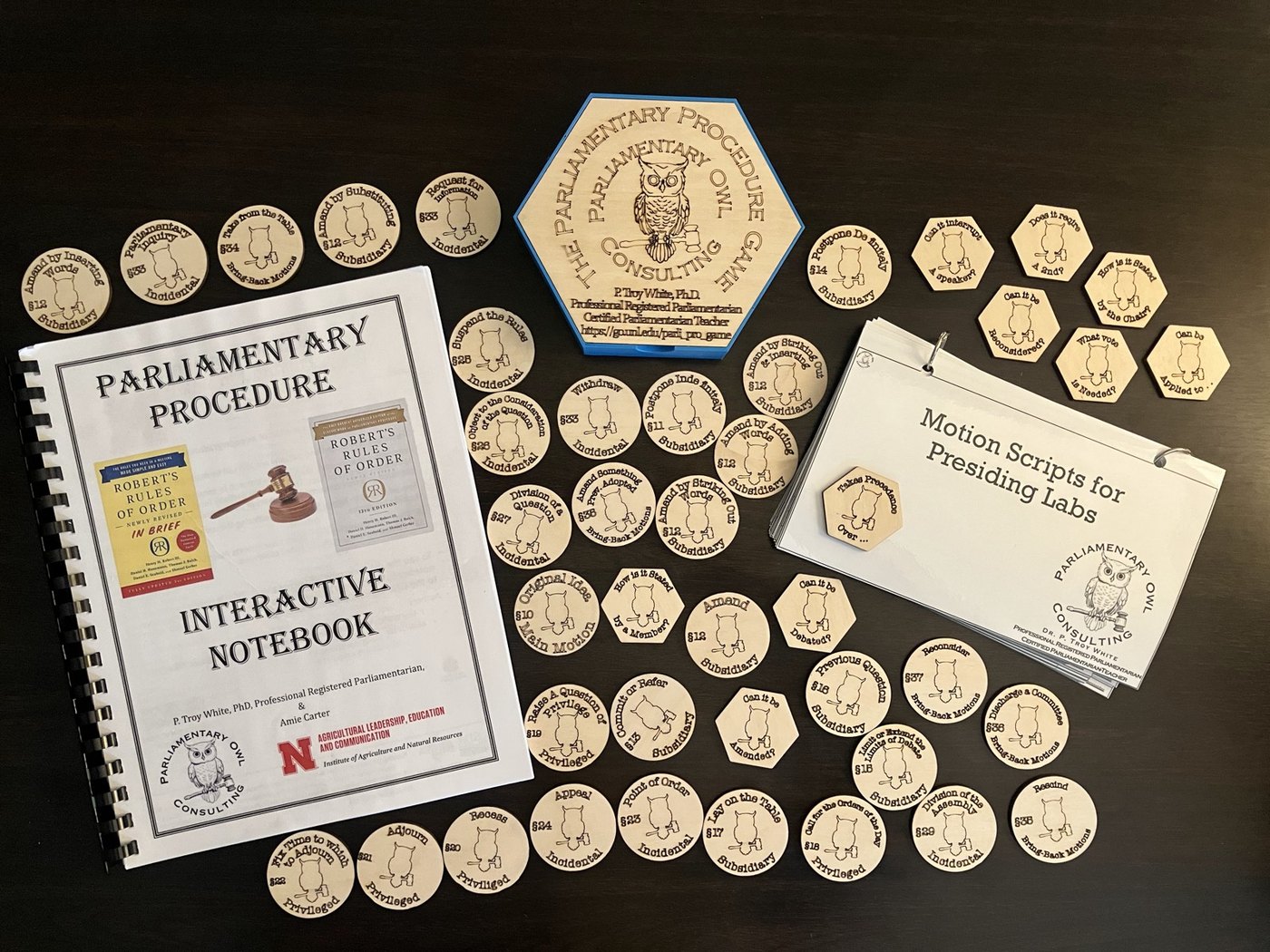
Nine games built on one set of motion chips — a precedence speed test, an SDC round, a mock meeting, and a presiding practicum. Free to use, download, and share.
A complete set: 36 motion chips, 8 SDC prompt hexes, the presiding-lab script deck,
and the Interactive Notebook. The cut files are at the bottom of this page.
Free to use, download, and share — please attribute to
Parliamentary Owl Consulting and the University of
Nebraska–Lincoln. Pre-made sets are available for
purchase; email theagteacher@icloud.com for pricing and availability.
Pre-made games are available for purchase. Email Dr White (theagteacher@icloud.com) for pricing and availability.
This game is designed to be used in the teaching and review of parliamentary procedure. The following activities can all be played with combinations of the various pieces.
The Precedence Speed Test
What’s the Immediately Pending Question
Standard Descriptive Characteristics
How would I say that?
Let’s have a meeting!
That’s Classy
What’s that Do?
Let’s improve that together.
Presiding Practicum
1. The Precedence Speed Test
Base directions: Draw a set number of motion chips — start with 4–5 and progress to all 13 ranked motions plus select incidental motions as proficiency grows — and race to place them in the correct order of precedence. Speed Variation: use two sets of chips for head-to-head or tournament play.
Enhancement: Before starting the next round, the player must choose one adjacent pair from their completed line and explain aloud why the higher-ranked motion outranks the lower-ranked one. This converts a pure speed drill into a meaning-based exercise, consistent with the finding that understanding why a rule exists produces more durable learning than rote repetition (Noice & Noice, 2006).
Reflection integration: Draw one Appendix A, Category A (Procedural Function) card after every round, win or lose.
Spacing note: Do not treat one winning streak as mastery. Replay this game at least twice more across the training cycle — for example, one week later and again a month later — since distributed practice produces substantially better long-term retention than massed, single-session repetition (Dunlosky et al., 2013).
2. What’s the Immediately Pending Question?
Base directions: Players draw 5 motion chips at random and determine the correct order the motions would be voted on if an order of Previous Question on All Pending Business were passed. Speed Variation: two sets of chips, head-to-head or tournament play.
Enhancement: Replace the informal “add chips as players gain proficiency” guidance with a tracked five-level ladder: Level 1 (3 chips), Level 2 (4 chips), Level 3 (5 chips), Level 4 (6 chips), Level 5 (7+ chips including at least one incidental motion). A player must sequence correctly twice in a row at a level before advancing to the next. Record each player’s current level across sessions rather than restarting each time. This makes the game’s own implicit scaffolding an explicit, consistent Zone of Proximal Development ladder (Vygotsky, 1978; Wood, Bruner, & Ross, 1976).
Reflection integration: After each successful sequencing (not each attempt), draw one Appendix A, Category B (RONR Authority and Citation Recall) card and answer it using the chips just played, before advancing to the next level.
3. Standard Descriptive Characteristics (SDC)
Base directions: Players each pick a chip; one SDC is selected from the list (interrupt, second required, debatable, amendable, vote required, reconsiderable); players answer the SDC for the chip drawn, continuing until they answer incorrectly.
Enhancement: Before drawing the next chip, the player must add a one-sentence “because” justification for the SDC answer just given (e.g., “This motion requires a second because it needs at least one other member on record supporting consideration”). In the Jeopardy variant, points are awarded only once the justification is given, not on the bare correct/incorrect answer. This pushes the activity from classification toward genuine understanding (Dewey, 1938).
Reflection integration: Use Appendix A, Category A prompts as a warm-up before starting the grid or Jeopardy variants, so players have already rehearsed “why” thinking before the timed format begins.
Alterations:
Play rotates from player to player with each answering the same SDC for the chip they draw. When a player misses the SDC, the next player can try to answer it and if correct, keeps drawing chips until they incorrectly identify the SDC.
Using a 6x7 table printed 4 to a page for players to answer on, each numbered 1-5. Then draw 5 motion chips and face them motion side down. When all chips are drawn, flip all the chips over and students have 10 seconds to try and correctly identify as many SDC’s for the chosen motions.
Motion Chip
Can it Interrupt a speaker?
Is a Second Req.?
Is it debatable?
Can it be Amended
Vote Req.
Can it be Reconsidered?
Jeopardy Version. 25 chips are randomly placed face down in a 5x5 grid. One SDC is placed at the top of each column of chips. Players select chips in jeopardy fashion with the rows values (1-5) and the column header (one SDC). Most points wins. The grid can be expanded as needed for additional players to participate.
4. How Would I Say That?
Base directions: Players draw a motion chip and state the correct verbiage to make the motion, continuing until they state it incorrectly (checked against Table 3 in RONR). Alternatives: state the chair’s wording instead of the member’s; state both.
Enhancement: Players must stand, address an imaginary chair or assembly, and use correct presiding posture and gesture (e.g., rising and addressing the chair for a motion that requires recognition) while stating the wording, rather than remaining seated. Physical enactment paired with verbatim recall produces significantly better long-term retention than stationary recitation (Noice, Noice, & Kennedy, 2000).
Reflection integration: After an incorrect statement ends a player’s turn, draw one Appendix A, Category C (Error Analysis and Debrief) card before the next player begins.
5. Let’s Have a Meeting!
Base directions: Players create a sample agenda with at least two unique business items; each player draws two motion chips; in a mock meeting, players collaborate to complete the agenda and process their drawn motions within a set time. Completed agenda items are worth 50 points, completed motions 10 points, with up to 5 additional points for debate quality.
Enhancement: When time expires, scoring is not finalized until the group completes a mandatory two-minute structured debrief, led by a rotating “reflection leader” role. Hands-on practice becomes educative only once it is paired with deliberate reflection on what happened and why (Dewey, 1938; Kolb, 1984); without this step the exercise risks producing fluent repetition without producing understanding.
Reflection integration: The reflection leader draws two Appendix A, Category C cards and poses them to the group before points are recorded.
6. That’s Classy
Base directions: Players take turns as caller, stating the motion on a drawn chip; the active player must correctly identify its class (main, subsidiary, privileged, incidental, or motions that bring a question again before the assembly). Correctly answered chips are kept; most chips wins.
Enhancement: Once a player wins three consecutive rounds using game chips, that player moves to a “transfer round” using motions drawn from real meeting minutes, bylaws, or the sample main motions list in this resource, rather than only game chips. This tests whether classification skill has generalized beyond the specific chip set, since skill built on a fixed set of examples does not automatically transfer to novel material at this age (Veenman & Spaans, 2005).
Reflection integration: The transfer round opens with one Appendix A, Category F (Transfer and Domain-General Check) card.
7. What’s That Do?
Base directions (unchanged): Chips are shuffled face down; players have 30 seconds to turn over chips, describing each motion’s purpose before turning the next, with peer judges confirming correctness. Alternatives: head-to-head with two chip sets; a “grab” version where a fourth player reads a purpose aloud and three players race to grab the matching chip after the chair-style prompt “Are you ready for the question?”
Enhancement added: In the grab variant, add a mandatory three-second pause after the prompt before any player may grab a chip, enforced by the reading player. This prevents the game from rewarding a fast-but-wrong guess over a correct answer that took an extra beat to retrieve, and gives slower-processing learners a fair chance to complete their reasoning.
Reflection integration: The existing peer-judge requirement already functions as a built-in Category A check; no additional card is required, though instructors may insert one Category A card per round for newer groups.
8. Let’s Improve That Together
Base directions (unchanged): Two teams of five players each randomly draw one of six amendment-variation chips; using a randomly chosen main motion, teams improve it using as many of their selected amendment methods as possible, respecting the settled clause (RONR §12:25) and the germaneness rule (RONR §12:18); a chairman judges which team’s motion is most improved, considering completeness (who, what, when, where, how).
Enhancement added: Add a rotating “reporter” role: every team member, not only the most confident, must serve as reporter for at least one amendment during the round and explain that choice to the chairman. This distributes accountability across the whole team rather than allowing less-confident members to contribute passively while a stronger member drives the round.
Reflection integration: Each reporter answers one Appendix A, Category B card when explaining their amendment to the chairman. When playing with adult RP/PRP candidates, substitute Category E (Adult Relevance and Governance Case) cards instead.
9. Presiding Practicum
Base directions: Beginning at the new-business section of the agenda, each participant processes one main motion while presiding; audience members draw two motions at random each rotation, with a minimum of four motions applied per rotation and every audience member debating at least once. Slide-deck scripts (Presiding Practice Lab Scripts, Presiding Scripts CCM LDE Only, Presiding Scripts PPro LDE Only) assist with correct presiding verbiage.
Enhancement — structured debrief: After each participant’s turn presiding, before the next participant assumes the chair, conduct a mandatory two-minute debrief. This is the single highest-value addition identified in the assessment table, since Presiding Practicum is the activity most reliant on hands-on performance and therefore most in need of the reflection step that converts performance into learning (Dewey, 1938; Kolb, 1984).
Enhancement — fading the script: Run the same practicum scenario across three sessions of a training cycle with the slide-deck script deliberately withdrawn in stages: Session 1 uses the full script; Session 2 uses a partial script with only RONR citations retained and full sentences removed; Session 3 uses no script. This operationalizes the fading principle from the scaffolding literature (Wood, Bruner, & Ross, 1976) as a planned progression rather than leaving the script in place indefinitely or removing it all at once.
Reflection integration: The post-turn debrief draws two reflection prompts, Category C cards for youth participants, or one Category C and one Category E card for adult RP/PRP candidates.
Variations: (1) Adjust the number of motions to process; (2) Determine as a group how ___(#) motion chips drawn at random could be applied to the selected main motion and then create a script for making and processing those motions in the pre-determined order; (3) Advanced Challenge: Members select chips until there are not enough for an even number to be drawn. Members of the assembly are trying to be the first member to use all their chips. If a member tries to use a chip and the chair (and assembly) determines it is out of order, they suffer a 5 minute penalty where they are not allowed to make any motions. First member to use all their chips wins. (4)Using scenario #3, apply points to the chips based on the level of difficulty of performing the drawn motion. In this variation, the highest points earned when the first member goes out wins.
Reflection Prompts
This appendix develops the Reflection Prompt Cards suggested in the game assessment above into a full, ready-to-print deck. The prompts operationalize Dewey’s (1938) claim that hands-on experience becomes educative only through deliberate reflection, and Zimmerman’s (2002) self-regulated learning cycle, by supplying the monitoring questions directly rather than assuming a learner will generate them unprompted — appropriate given adolescents’ still-domain-specific metacognition (Veenman & Spaans, 2005) and useful as an optional deepening step for adult candidates as well.
Suggested use: after any round of any game in this document’s assessment table, one player draws a single card from the relevant category (or the whole deck, shuffled together) and answers aloud before play continues. Cards are grouped by category below; each category notes which existing games it pairs with best, though any card can be used with any game.
Categories map loosely onto Kolb’s experiential learning cycle: Categories C and D function as reflective observation, Category F functions as abstract conceptualization, and the next game round functions as active experimentation. Treat a Category F card as a required step in that sequence, not an optional extra — see Category F below for why.
A. Procedural Function (“Why This Rule Exists”)
Pairs well with: How would I say that?, Standard Descriptive Characteristics, That’s Classy, What’s that Do?
Why does this motion require a second, but a Point of Order does not?
What problem was this motion designed to solve for the assembly?
Why must this motion be stated by the chair in this specific wording rather than paraphrased?
What would go wrong procedurally if this motion were skipped entirely?
Why does this motion rank where it does in the order of precedence?
What is the difference between what this motion does and what a similar-sounding motion does?
B. RONR Authority and Citation Recall
Pairs well with: Presiding Practicum, Let’s have a meeting!, Let’s improve that together
Which section of RONR supports the ruling you just made?
If a member challenged this ruling right now, what would you cite to defend it?
What is the exact vote threshold required here, and why is it set at that level rather than a simple majority?
Which rule would you point to if asked whether this amendment is germane?
What RONR section governs what happens next if this motion fails?
C. Error Analysis and Debrief
Pairs well with: Let’s have a meeting!, Presiding Practicum — use after every round, not only after mistakes
What is one thing you would do differently if you presided over this same scenario again?
Where did you hesitate, and what were you trying to figure out in that moment?
What ruling or wording were you least confident about, and why?
If a newer member watched you just now, what might they misunderstand about what you did?
What pattern do you notice between this mistake and mistakes you’ve made before?
D. Self-Monitoring and Calibration
Pairs well with: any speed or drawing game, especially for adolescent learners — use one “before” and one “after” prompt per round
Before you draw a chip: on a scale of 1–5, how confident are you that you can state this motion correctly?
After answering: were you right about your own confidence? What surprised you?
What is your specific goal for the next round — not “do better,” but one exact behavior?
Which part of this game do you always get right without stopping to think? Which part always makes you pause?
If you got this wrong, was it because you didn’t know the rule, or because you knew it but stated it incorrectly under pressure?
E. Adult Relevance and Governance Case
Pairs well with: Presiding Practicum, Let’s improve that together — for adult RP/PRP candidates
Have you seen a real meeting mishandle this exact motion? What happened?
How would this ruling change if your own organization’s bylaws included a special rule on this topic?
What would you tell a new board member who tried to make this motion incorrectly at a real meeting?
Where in your own governance experience would this motion actually come up?
What is the real-world cost to an organization of getting this ruling wrong?
F. Transfer and Domain-General Check (Kolb’s Abstract Conceptualization Stage)
Use as a required step after every round’s error-analysis debrief — not only once a player is winning consistently. This is the stage research on Kolb’s cycle finds most often skipped in practice (Villarroel Henríquez et al., 2025); making it a required step, not an optional advanced check, is what closes that gap here. Also tests whether learning has transferred beyond the game deck (Veenman & Spaans, 2005).
Could you apply this same rule to a motion that wasn’t in the game deck? Try one.
Explain this rule to someone who has never played the game, using a real meeting example.
What is the general principle behind this specific rule that would still apply even if RONR’s exact wording changed?
Slide Decks for assisting the presiding officer with verbiage during the Presiding Practicum Game.
§6:1 “A main motion is a motion whose introduction brings business before the assembly.”
Stated by the Member
Member A (obtaining the floor): “I move that . . .” (Second.)
Stated by the Chair
Chair: It is moved and seconded that _______
§10 Incidental Main Motion
InterruptNo
2nd requiredYes
DebatableYes
AmendableYes
Vote requiredMaj.
ReconsiderYes
Purpose
§10:4 “An incidental main motion is a main motion that is incidental to or relates to the business of the assembly, or its past or future action.” §6:9 For each of the subsidiary motions Amend, Commit, Postpone Definitely, and Limit or Extend Limits of Debate, §6:13 For the motions to Recess, to Adjourn, and to Fix the Time to Which to Adjourn, there are corresponding incidental main motions of the same names (§10:4–5).
Stated by the Member
Member A (obtaining the floor): “I move that . . .” (Second.)
Stated by the Chair
Chair: It is moved and seconded that _______.
Subsidiary Motions
§11 Postpone Indefinitely
InterruptNo
2nd requiredYes
DebatableYes
AmendableNo
Vote requiredMaj.
ReconsiderPositive only
Purpose
§6:5(1) “If an embarrassing main motion has been brought before the assembly, a member can propose to dispose of this question without bringing it to a direct vote, by moving to Postpone Indefinitely.”
Stated by the Member
MEMBER A (obtaining the floor): I move that the motion be postponed indefinitely. (Second.)
Stated by the Chair
CHAIR: It is moved and seconded that the motion pertaining to _______ be postponed indefinitely.
§12 Amend
InterruptNo
2nd requiredYes
DebatableYes
AmendableYes
Vote requiredMaj.
ReconsiderYes
Purpose
§6:5(2) “If a motion might be more suitable or acceptable in an altered form, a proposal to change its wording (either to clarify or, within limits, to modify the meaning) before the motion is voted on can be introduced by moving to Amend.”§6:7 “When the motion to Amend is applied to another subsidiary motion, its rank is modified so that it takes precedence over the motion to which it is applied, even if that motion ranks higher than Amend in the regular order of precedence of motions.”
Stated by the Member
MEMBER A (obtaining the floor): I move to ___________ the words “_________[clearly state location if inserting, striking, or inserting and striking; adding words are placed at the end of the motion].” (Second.)
Stated by the Chair
CHAIR: It is moved and seconded to ________ the words “______.” If the amendment is adopted, the main motion will read, “_______.” The question is on ________ the words “_____________.”
§13 Commit or Refer
InterruptNo
2nd requiredYes
DebatableYes
AmendableYes
Vote requiredMaj.
ReconsiderYes
Purpose
§6:5(3) If; “it would be better to turn the motion or resolution over to a committee for study or redrafting before the assembly considers it further. Such action can be proposed by moving to Commit the main question—or Refer it to a committee.”
Stated by the Member
MEMBER A (obtaining the floor): I move to refer this to the ___[standing] committee with [list any special instruction to the committee].OR,IF CREATING A SPECIAL COMMITTEEMEMBER A (obtaining the floor): I move to refer this to a committee of:a) number or names of members of the committee and their method of selectionb) instructions to the committee (may include)i. when to meetii. how to consider the motioniii. when it is to reportiv. powers, if anyv. any other instructions for the committee regarding when, how, or other details the assembly feels they need.
Stated by the Chair
CHAIR: It is moved and seconded to refer the motion (or resolution) to ____ [list the details as provided by MEMBER A].
§14 Postpone Definitely
InterruptNo
2nd requiredYes
DebatableYes
AmendableYes
Vote requiredMaj.
ReconsiderYes
Purpose
§6:5(4) “If the assembly might prefer to consider the main motion later in the same meeting or at another meeting, this can be proposed by moving to Postpone to a Certain Time—also called the motion to Postpone Definitely, or simply to Postpone.”
Stated by the Member
MEMBER A: I move to postpone the motion pertaining to [subject or question] until [time; not beyond the next regularly scheduled motion].
Stated by the Chair
CHAIR: It is moved and seconded that the motion pertaining to [subject or question] be postponed until [certain time; no later than the next regularly scheduled meeting].ORCHAIR: Are you ready for the question? [Handle debate.]CHAIR: The question is on the motion to postpone the motion pertaining to [subject or question] until [time]. Those in favor of the motion, say aye. [ Pause] Those opposed, say no. [Pause]CHAIR: The ayes have it, the motion is adopted. The motion pertaining to [subject or question] is postponed until [time].CHAIR: The next item of business is … ORCHAIR: The noes have it, the motion is lost. The question is on the motion that (to) ___ [stating the immediately pending question].
§15 Limit or Extend Limits of Debate
InterruptNo
2nd requiredYes
DebatableNo
AmendableYes
Vote required2/3
ReconsiderYes
Purpose
§6:5(5) “If it is desired to continue consideration of a motion but debate is consuming too much time, a member can move to place a limit on the debate; on the other hand, if special circumstances make it advisable to permit more or longer speeches than under the usual rules, a motion to do so can be made; or, it may sometimes be desirable to combine the elements of limitation and extension, as in limiting the length of speeches but allowing more speeches per member. All such modifications of the normal limits of debate on a pending motion are proposed by means of the motion to Limit or Extend Limits of Debate.”
Stated by the Member
MEMBER A: I move that at [certain time] debate be closed and the question on the motion be put.ORMEMBER A: I move to limit (extend the limits of) debate on the pending motion to [certain time].ORMEMBER A: I move that debate be limited (or extended) to [number] speeches of [number] minutes.
Stated by the Chair
CHAIR: It is moved and seconded that at [certain time] debate be closed and the question on the motion be put.ORCHAIR: It is moved and seconded to limit (extend the limits of) debate on the pending motion to [certain time].ORCHAIR: It is moved and seconded that debate be limited (or extended) to [repeating number] speeches of [repeating number] minutes.CHAIR: Are you ready for the question? [Handle any amendment(s)]CHAIR: The question is on [repeating motion]. Those in favor of the motion will rise.[Pause] Be seated. Those opposed will rise. [Pause] Be seated.CHAIR: There are two-thirds in the affirmative; the motion is adopted. [Make a statement indicating the effect of the vote and/or ordering its execution.]CHAIR: The question is on [stating the pending motion].ORCHAIR: There are less than two-thirds in the affirmative; the motion is lost. The question is on [repeating the pending motion].
§16 Previous Question
InterruptNo
2nd requiredYes
DebatableNo
AmendableNo
Vote required2/3
ReconsiderYes
Purpose
§6:5(6) “If it is desired to close debate and amendment of a pending motion so that it will come to an immediate vote, this can be proposed by moving the Previous Question.”
Stated by the Member
MEMBER A: I call/move the previous question.-OR- MEMBER A: I call/move the previous question on [name the motions on which it will apply]
Stated by the Chair
CHAIR: The previous question is called/moved.-OR-CHAIR: The previous question is called/moved on [naming the motion(s) unless none was specified].CHAIR: The question is on ordering the previous question on [Repeating the motion(s) unless none was specified].CHAIR: Those in favor of ordering the previous question on [repeating the motion(s) unless none was specified] will rise. [Pause] Be seated. Those opposed will rise. [Pause] Be seated.CHAIR: There are two-thirds in the affirmative and the previous question is ordered on [naming motion(s) to which the order applies].The question is now on [stating the question on the immediately pending motion].-OR-CHAIR: There are less than two-thirds in the affirmative and the motion for the previous question is lost. The question is now on [stating the immediately pending motion].
§17 Lay on the Table
InterruptNo
2nd requiredYes
DebatableNo
AmendableNo
Vote requiredMaj.
ReconsiderNegative only
Purpose
§6:5(7) “If there is reason for the assembly to lay the main motion aside temporarily without setting a time for resuming its consideration, but with the provision that it can be taken up again whenever a majority so decides, this can be proposed by the motion to Lay on the Table.”
Stated by the Member
MEMBER A: [Stating more urgent business or need]. I move to lay the pending question(s) on the table.OR MEMBER A: [Stating more urgent business or need]. I move that the pending resolution(s) be laid on the table.
Stated by the Chair
CHAIR: It is moved and seconded to lay the pending question(s) on the table. The question is on the adoption of the motion to lay the pendingquestion(s) on the table. Those in favor of the motion, say aye. [Pause] Those opposed, say no. [Pause]CHAIR: The ayes have it; the motion is adopted. The pending question(s) is (are) laid on the table. The next item of business is [stating the business to be taken up].ORCHAIR: The noes have-it; the motion is lost. The question is on the motion that (to) [repeating the immediately pending question].
Privileged Motions
§18 Call for the Orders of the Day
InterruptYes
2nd requiredNo
DebatableNo
AmendableNo
Vote requiredNo vote, demand
ReconsiderNo
Purpose
§6:12(1) “If the adopted program or order of business is not being followed, or if consideration of a question has been set for the present time and is now in order but the matter is not being taken up, a single member, by making a Call for the Orders of the Day.”
Stated by the Member
MEMBER A (rising and addressing the chair): Madam President, I call for the orders of the day.
Stated by the Chair
CHAIR: The orders of the day are called for. The orders of the day are ___ [identifying the business that is on the card]. Is there any debate?CHAIR: (Handles debate if any)CHAIR: Are you ready for the question? [Pause] Seeing no further debate, we will vote on the pending motion, which is (read from card). Those in favor say “aye” [Pause] Those opposed say “no”CHAIR: [Announce the result and action]CHAIR: When the orders of the day were called for, the chapter was considering [state what was pending]. Are you ready for the question? [resume exactly where the assembly was when the call was made]OR IF THE ASSEMBLY DOES NOT APPEAR TO WANT TO TAKE UP THE ORDERCHAIR: The orders of the day are called for. The orders of the day are ___ [identifying the business on the card].The question is: "Will the assembly proceed to the orders of the day? Those in favor of proceeding to the orders of the day will rise. [Pause] Be seated. Those opposed will rise. [Pause] Be seated.There are two-thirds opposed to the motion. The assembly will not proceed to the orders of the day.[Resume pending business.]
§19 Raise a Question of Privilege
InterruptYes
2nd requiredNo
DebatableNo
AmendableNo
Vote requiredChair Grants
ReconsiderNo
Purpose
§6:12(2) “If a pressing situation is affecting a right or privilege of the assembly or of an individual member (for example, noise, inadequate ventilation, introduction of a confidential subject in the presence of guests, etc.), a member can Raise a Question of Privilege (19), which permits him to interrupt pending business to state an urgent request or motion.”
Stated by the Member
MEMBER A (rising and addressing the chair without pausing): Mr. President, I rise to a question of privilege affecting the assembly [OR a question of personal privilege].
Stated by the Chair
CHAIR: The member will state their question.MEMBER A: Mr. President, [states the question of privilege]CHAIR: [Addresses the question of privilege]
§20 Recess
InterruptNo
2nd requiredYes
DebatableNo
AmendableYes
Vote requiredMaj.
ReconsiderNo
Purpose
§6:12(3) “A short intermission in a meeting, even while business is pending, can be proposed by moving to Recess (20) for a specified length of time.”
Stated by the Member
MEMBER A (obtaining the floor): I move to recess for [number] of minutes -OR- until [time].
Stated by the Chair
CHAIR: It is moved and seconded to recess for [minutes] -OR- until [time]. Are there any amendments? [Handle amendments]CHAIR: Are you ready for the question? The question is on recessing for [time]. All those in favor say aye. [Pause] All those opposed say no. [Pause]CHAIR: [Announce the result of the vote]
§21 Adjourn
InterruptNo
2nd requiredYes
DebatableNo
AmendableNo
Vote requiredMaj.
ReconsiderNo
Purpose
§6:12(4) “A member can propose to close the meeting entirely by moving to Adjourn.”
Stated by the Member
MEMBER A: I move to adjourn.
Stated by the Chair
CHAIR: It is moved that we adjourn. Unless there are any objections [Pause], we stand adjourned.-OR- [If there is an objection, take a voice vote]; CHAIR: All those in favor say aye. [Pause] All those opposed say no. [Pause]CHAIR: [Announce the result of the vote]
§22 Fix the Time to Which to Adjourn
InterruptNo
2nd requiredYes
DebatableNo
AmendableYes
Vote requiredMaj.
ReconsiderYes
Purpose
§6:12(5) “Under certain conditions while business is pending, the assembly—before adjourning or postponing the pending business—may wish to fix a date and hour, and sometimes the place, for another meeting, or (in an established society) for another meeting before the next regular meeting. In cases of this kind, the motion to Fix the Time to Which to Adjourn (22) can be made—even while a matter is pending—unless another meeting is already scheduled for later within the same session. This is the highest-ranking of all motions.”
Stated by the Member
MEMBER A (obtaining the floor): Madam President, I move that when this meeting adjourns, it stand to meet at [time] on [date], at [location]. (Second.)
Stated by the Chair
CHAIR: It is moved and seconded that when this meeting adjourn it adjourns to meet at [time, date, & location]. [Handle amendments]CHAIR: Are you ready for the question? [Handle amendments]CHAIR: The question is on fixing the time to which to adjourn to [time, date, & location]. All those in favor say aye. [Pause] All those opposed say no. [Pause]CHAIR: [Announce the result of the vote]
Incidental Motions
§6:17 “An incidental motion is in order only when it is legitimately incidental to another pending motion, or when it is legitimately incidental in some other way to business at hand (see 6:15); it then takes precedence over any other motions that are pending.”
§23 Point of Order
InterruptYes
2nd requiredNo
DebatableNo
AmendableNo
Vote requiredNormally no vote, chair rules
ReconsiderNo
Purpose
§6:17(1) “Although the presiding officer has the responsibility of enforcing the rules, any member who believes he has noticed a case where the chair is failing to do so can, at the time the breach occurs, call attention to it by making a Point of Order.”
Stated by the Member
MEMBER A: I rise to a point of order. OR MEMBER A: Point of Order! Anyone who is speaking takes his seat.
Stated by the Chair
CHAIR: State your point of order.MEMBER A: I make the point of order that…CHAIR: The point of order is well taken [briefly stating the reason and taking any action if needed.]ORCHAIR: The point of order is not well taken [briefly stating the reason].
§24 Appeal
InterruptYes
2nd requiredYes
DebatableYes
AmendableNo
Vote requiredMaj.
ReconsiderYes
Purpose
§6:17(2) “Although the duty of ruling on all questions of parliamentary procedure affecting the assembly’s proceedings rests with the chair, any two members, by moving and seconding an Appeal (24) immediately after the chair has made such a ruling, can require him to submit the matter to a vote of the assembly.”
Stated by the Member
MEMBER A: I appeal the decision of the chair!
Stated by the Chair
CHAIR: The decision of the chair is appealed from. [The chair clearly states what the exact issue is and can explain the reasons for their decision if they choose.]CHAIR: The question is, ‘Shall the decision of the chair be sustained?’ An aye vote is a vote to agree with the decision of the chair. A no vote is a vote that disagrees with the decision of the chair. Those in favor of sustaining the chair's decision, say aye. [ *Pause] Those opposed to sustaining his decision, say no. [Pause]CHAIR: [Declare the outcome of the vote and resulting action]* The ayes have it and the decision of the chair is sustained. [Make a statement indicating the effect of the vote and/or ordering it’s execution.]ORThe noes have it and the chair's decision is not sustained. [Make a statement indicating the effect of the vote.]
§25 Suspend the Rules
InterruptNo
2nd requiredYes
DebatableNo
AmendableNo
Vote requiredRules of Order–⅔ Standing Rules - Majoritysee 25:2(7) for exception
ReconsiderNo
Purpose
§6:17(3) “When it is desired that the assembly take up a question or do something that would be in violation of a rule that applies, it can be proposed in some cases to Suspend the Rules (25) to permit accomplishment of the desired purpose.”
Stated by the Member
MEMBER A (obtaining the floor): I move that the rules be suspended which interfere with… [briefly stating the object of the suspension and rational]. (Second.)
Stated by the Chair
CHAIR: It is moved to suspend the [type (Ordinary standing rule vs. parliamentary rule of order)] rule which interferes with . . . [briefly stating the object of the suspension]. CHAIR [for parliamentary rules of order]: All those in favor of suspending the rules interfering with [object] will rise. [Pause] Be seated. Those opposed will rise. [Pause] Be seated.CHAIR: There are two thirds in the affirmative and the rules are suspended for the purpose of… OR CHAIR [for standing rules]: All those in favor of suspending the rules interfering with [object] say aye. [Pause] Those opposed say no. [Pause]CHAIR: The ayes have it and the rules are suspended for the purpose of… ORCHAIR: The noes have it and the rules are not suspended.
§26 Obj. to the Consideration of a Question
InterruptYes, until debate has begun or subsidiarymotion other than Lay on the Table has been stated by the chair
2nd requiredNo
DebatableNo
AmendableNo
Vote required⅔ against consideration sustains the objection
ReconsiderNegative only
Purpose
§6:17(4) “If an original main motion has been made and a member believes that it would do harm for the motion even to be discussed in the meeting, he can raise an Objection to the Consideration of the Question (26), provided he does so before debate has begun or any subsidiary motion (other than a motion to Lay on the Table) has been stated.”
Stated by the Member
MEMBER A rises, even if another has been assigned the floor, and without waiting to be recognized, addresses the chair:MEMBER A: Mr. President, I object to the consideration of the question!
Stated by the Chair
CHAIR: The consideration of the question is objected to. Shall the question be considered? Those in favor of considering it, rise [PAUSE], Be seated. Those opposed to considering the question, rise [PAUSE], Be seated. There are two-thirds opposed and the question will not be considered.-OR-CHAIR: There are less than two-thirds opposed and the objection is not sustained. The question is on [state the motion which was objected to]. Are you ready for the question?
§27 Division of a Question
InterruptNo
2nd requiredYes
DebatableNo
AmendableYes
Vote requiredMaj.
ReconsiderNo
Purpose
§6:17(5) “If a pending main motion (or a pending amendment) contains two or more parts capable of standing as separate questions, the assembly can vote to treat each part accordingly in succession; such a course is proposed by the motion for Division of a Question (27).”
Stated by the Member
MEMBER A (obtaining the floor): Madam President, I move to divide the resolution/motion into two parts as follows: . . . (Second.)
Stated by the Chair
CHAIR: Are you ready for the question? [Handle amendment(s)]CHAIR: The question is on the division of the motion so as to consider separately [repeating the motion].CHAIR: Those in favor of the motion, say aye. [Pause] Those opposed, say no. [Pause] The ayes have it; the motion is adopted. The question will be divided.CHAIR: The question is on the motion that (to) [repeating first part of original main motion].ORCHAIR: The noes have it; the motion is lost. The question is on the motion that (to) [repeating original main motion].
§28 Consideration by Paragraph or Seriatim
InterruptNo
2nd requiredYes
DebatableNo
AmendableYes
Vote requiredMajority
ReconsiderNo
Purpose
§6:17(6) “If the main motion is in the form of a resolution or document containing several paragraphs or sections which (although not separate questions) could be most efficiently handled by opening each paragraph or section to amendment one at a time (before the whole is finally voted on), such a procedure can be proposed by the motion for Consideration by Paragraph or Seriatim (28).”
Stated by the Member
MEMBER A: I move that the resolution be considered by paragraph.
Stated by the Chair
CHAIR: It is moved and seconded to consider the motion by paragraph. CHAIR: Those in favor of considering the motion by paragraph, say aye. [Pause] Those opposed, say no. [Pause] The ayes have it; the motion is adopted. The question will be considered by paragraph. The first paragraph to be considered is . . . OR CHAIR: The motion fails, we will not consider it by paragraph.
§29 Division of the Assembly
InterruptYes
2nd requiredNo
DebatableNo
AmendableNo
Vote requiredNo vote, demand
ReconsiderNo
Purpose
§6:17(7) “If a member doubts the accuracy of the chair’s announcement of the result of a voice vote (or even a vote by show of hands)—or doubts that a representative number of persons voted—he can demand a Division of the Assembly (29); a single member thus has the power to require a standing vote, but not to order a count, which only the chair or the assembly can do.”
Stated by the Member
MEMBER A: Division! OR I question the outcome of the vote! OR I call for [or “demand”] a division.
Stated by the Chair
CHAIR: A division is called OR demanded. Those in favor of [state motion/resolution], rise [PAUSE], Be seated. Those opposed, rise [PAUSE], Be seated. The ayes/noes have it and the motion is adopted/lost, we will/will not . . .
§30 Methods of Voting
InterruptNo
2nd requiredYes
DebatableNo
AmendableYes
Vote requiredMaj.
ReconsiderTo close polls, no; to reopen polls, negative vote only: all others, yes.
Purpose
§6:17(8) “A member can move that a vote be taken (a) by ballot, (b) by roll call, or (c) by a counted standing vote, especially if a division of the assembly has appeared inconclusive and the chair neglects to order a count.”
Stated by the Member
Member A: I move that the vote be taken by [state desired method].
Stated by the Chair
CHAIR: It is moved and seconded to vote by [method]. Are there any amendments? [PAUSE]; [Handle Amendments]CHAIR: Those in favor of voting by [method], say aye. [Pause] Those opposed, say no. [Pause] The ayes have it; the motion is adopted. The question will be voted on by [method].
§31 Motions Relating to Nominations
InterruptNo
2nd requiredYes
DebatableNo
AmendableYes
Vote requiredMajority
ReconsiderYes
Purpose
§6:17(9) “If the bylaws or rules of the organization do not prescribe how nominations are to be made, and if the assembly has taken no action to do so prior to an election, any member can move while the election is pending (a) to specify one of various methods by which the candidates shall be nominated; or, if the need arises, (b) to close nominations, or (c) to reopen them; these are the Motions Relating to Nominations (31).”
Stated by the Member
Stated by the Chair
§32 Excused from a Duty
InterruptNo
2nd requiredYes, if made by member to be excused from duty, No if made by another member
DebatableYes
AmendableYes
Vote requiredMajority
ReconsiderNegative only
Purpose
§6:17(10) “A member may Request to Be Excused from a Duty (32) if he wishes to be relieved from an obligation imposed upon him by the bylaws or by virtue of some position or office he holds.”
Stated by the Member
MEMBER A: I move [or “ask”] that I be excused from… ORMEMBER A: I move that the resignation be accepted.
Stated by the Chair
CHAIR: Member A has moved that they be excused from [duty]. Is there any debate?[Handle Debate]CHAIR: Are you ready for the question? The question is on excusing Member A from [duty]. Those in favor say ‘aye’ [pause], those opposed say ‘no.’ Motion carries and Member A is excused from [duty]
§33 Parliamentary Inquiry
InterruptYes
2nd requiredNo
DebatableNo
AmendableNo
Vote requiredChair answers
Reconsider–
Purpose
§6:17(11a) “Parliamentary Inquiry (a request for the chair’s opinion on a matter of parliamentary procedure as it relates to the business at hand—not involving a ruling).”
Stated by the Member
MEMBER A: I rise to a parliamentary inquiry. ORMEMBER A: Parliamentary inquiry, Mr. President!
Stated by the Chair
CHAIR: State your inquiry.MEMBER A: [States question related to parliamentary procedure or related to the rules of the organization having bearing on the current motion]CHAIR: [Provides their opinion on the correct answer, OR directs another member or the parliamentarian to answer the question]
§33 Request for Information
InterruptYes
2nd requiredNo
DebatableNo
AmendableNo
Vote requiredNo vote, chair responds
ReconsiderNo
Purpose
§6:17(11b) “Request for Information or, as it is also called, Point of Information (an inquiry as to facts affecting the business at hand—directed to the chair or, through the chair, to a member).”
Stated by the Member
MEMBER A: Madam Chairman, A request for information!
Stated by the Chair
CHAIR: State your request.MEMBER A: States requestCHAIR: [Answers request or asks another member to answer it]
§33 Withdraw or Modify a Motion
InterruptYes
2nd requiredNo
DebatableNo
AmendableNo
Vote requiredMaj.
ReconsiderNegative only
Purpose
§6:17(11c) “Request for Permission (or Leave) to Withdraw or Modify a Motion (after it has been stated by the chair).”
Stated by the Member
MEMBER A: I move that the member [or “I”] be permitted [or “allowed”] to withdraw the motion.
Stated by the Chair
CHAIR: If there are not any objections to allowing the·motion to be withdrawn; [PAUSE for objections] the motion is withdrawn. OR, If there is an objection:CHAIR: Since there is an objection, the question is on the member being permitted to withdraw the motion.Those in favor of the withdrawal, say aye. [Pause] Those opposed, say no. [ Pause] CHAIR: [Announce the outcome of the vote]
Motions that Bring Questions Again Before the Assembly
§34 Take from The Table
InterruptNo
2nd requiredYes
DebatableNo
AmendableNo
Vote requiredMaj.
ReconsiderNo
Purpose
§6:26(1) “If it is desired to resume consideration of a main motion (along with any series of motions that may be adhering to it which lies on the table, it can be proposed by means of the motion to Take from the Table (34).”
Stated by the Member
MEMBER A: I move to take from the table the resolution relating to [state motion] and [it’s pending questions/amendments, etc.]
Stated by the Chair
CHAIR: It is moved and seconded to take from the table the motion relating to [repeating motion taken from table].The question is on the motion to take from-the table the motion relating to [repeating motion taken from table].CHAIR:Those in favor of the motion, say aye. [ Pause] Those opposed, say no. [Pause] The ayes have it; the motion is adopted. [Make a statement indicating the effect of the vote.]CHAIR:The question is on the motion that (to)[repeating motion taken from table].ORCHAIR:The noes have it; the motion is lost.
§35 Rescind /Amend Something Previously Adopted
InterruptNo
2nd requiredYes
DebatableYes
AmendableYes
Vote required2/3, Maj. with notice, or Maj. of entire membership
ReconsiderNeg. vote only
Purpose
§6:26(2) “If it is desired to cancel or countermand an entire main motion, resolution, order, or rule that has been adopted and that has continuing force and effect, such action can be proposed by means of the motion to Rescind (or Repeal, or Annul, 35); and by another form of the same parliamentary motion—that is, the motion to Amend Something Previously Adopted (35)—it can be proposed to modify the wording or text previously adopted, or to substitute a different version.”
Stated by the Member
Member A: In accordance with the previous notice given, I move to rescind [read motion from card].
Stated by the Chair
CHAIR: It is moved and seconded that the motion relating to [reading motion as on the card] be rescinded.Are you ready for the question? [Handle debate if any]CHAIR: The question is on rescinding the motion relating to [read motion from card]. Those in favor, say aye. [Pause] Those opposed, say no. [Pause]CHAIR: [Make a statement indicating the effect of the vote and/or ordering its execution.] Is there further new business?
§36 Discharge a Committee
InterruptNo
2nd requiredYes
DebatableYes
AmendableNo
Vote required2/3, Maj. with notice, or Maj. of entire membership
ReconsiderNeg. vote only
Purpose
§6:26(3) “If a question has been referred, or a task has been assigned, to a committee that has not yet made its final report, and it is desired to take the matter out of the committee’s hands, either so that the assembly itself can consider or act upon it or so that it can be dropped, such action can be proposed by means of the motion to Discharge a Committee (36).”
Stated by the Member
MEMBER A: I move to discharge [state the motion] from consideration by the [standing committee name] committee.ORMEMBER A: I move to discharge the committee tasked with [state the motion] from further consideration of the motion.
Stated by the Chair
CHAIR: It is moved and seconded that the [ name of standing committee] committee be discharged from further consideration of [repeating motion]. Are you ready for the question?ORCHAIR: It is moved and seconded that the committee to which was referred [repeating motion] be discharged. Are you ready for the question?CHAIR: [Handle debate if any]CHAIR: The question is on the adoption of the motion to [repeating motion].(1) If no previous notice was given: Those in favor of the motion will rise. [Pause]Be seated. Those opposed will rise. [Pause] Be seated.(2) If previous notice was given: Those in favor say aye. [Pause] Those opposed, say no. [Pause] CHAIR:Declare the outcome of the vote There are two-thirds in the affirmative and the motion is adopted. OR There are less than two-thirds in the affirmative and the motion is lost.(2) The ayes have it; the motion is adopted. [Make a statement indicating the effect of the vote and/or ordering its execution.] Is there further new business? OR The noes have it; the motion is lost. [Make a statement indicating the effect of the vote.] Is there further new business?
§37 Reconsider
InterruptNo
2nd requiredYes
DebatableYes
AmendableNo
Vote requiredMaj.
ReconsiderNo
Purpose
§6:26(4) “If, in the same session that a motion has been voted on but no later than the same day or the next day on which a business meeting is held, new information or a changed situation makes it appear that a different result might reflect the true will of the assembly, a member who voted with the prevailing side can, by moving to Reconsider (37) the vote, propose that the question come before the assembly again as if it had not previously been voted on.”
Stated by the Member
MEMBER A: I move to reconsider the motion related to [state motion idea] from earlier in the meeting. I voted on the prevailing side.The member moving the reconsideration must state how he voted on the motion.
Stated by the Chair
If it is in order to take up the motion:CHAIR: It is moved and seconded to reconsider the vote on [repeating motion].ORIf it is not in order to take up the motion when it is moved:CHAIR: It is moved and seconded to reconsider the vote on [repeating motion]. The secretary will make a note of it. [Continue with the pending business.] Are you ready for the question?CHAIR: [Handle debate if a debatable motion].CHAIR: The question is on the motion to reconsider the vote on [repeating motion]. Those in favor of reconsidering the vote on [repeating motion], say aye. [Pause] Those opposed, say no. [Pause] CHAIR: The ayes have it; the vote on the motion is reconsidered. The question is now on the motion that (to)[repeating motion to be reconsidered].ORCHAIR: The noes have it; the motion to reconsider is lost. [Make a statement indicating the effect of the vote.] Is there further new business?
This Excel-based generator requires a desktop installed version of the current edition of MS Excel with macros enabled. It does not work with online versions of Excel.
Sample Main Motions
132 original main motions for use in any of the games on this page, grouped by subject. Each one introduces new business rather than acting on business already pending, so any of them can open a round of Let’s Have a Meeting or a turn in the Presiding Practicum. Nothing here names a particular organization or program — a service club, a professional association, a board, a union local, or a classroom can use the same list unchanged.
A motion phrased for your own assembly is always better than a borrowed one. Read these as patterns: swap the dollar figures, the months, and the place names for your own and the practice gets closer to the real meeting.
Fundraising and finance
That we hold an annual silent auction to benefit the scholarship fund.
That we set the annual membership dues at twenty-five dollars.
That we adopt the budget as presented by the finance committee.
That we establish a reserve fund equal to six months of operating expenses.
That we sell tickets to a community pancake breakfast as a spring fundraiser.
That we purchase a card reader so that members may pay dues electronically.
That we engage an independent accountant to review the treasurer's books each year.
That we hold a raffle at the summer picnic, with the proceeds going to the building fund.
That we waive dues for members who have belonged to the organization for fifty years.
That we apply to the community foundation for a grant to fund the youth program.
That we authorize the treasurer to open a separate savings account for capital projects.
That we sell advertising space in the annual program booklet.
That we reimburse officers for mileage at the current federal rate.
That we hold a benefit concert and donate the proceeds to the local food bank.
Community service and outreach
That we adopt a two-mile stretch of highway and organize a litter pickup each quarter.
That we plant one hundred trees along the riverfront trail this spring.
That we provide lunch for the volunteer crew building the new playground.
That we sponsor a blood drive at the community center in October.
That we collect winter coats for distribution through the county shelter.
That we build and install ten benches along the walking path.
That we host a free tax preparation clinic for older residents.
That we organize a neighborhood cleanup on the first Saturday in May.
That we donate five hundred dollars to the animal shelter's spay and neuter program.
That we staff a water station at the city half marathon.
That we assemble and deliver fifty holiday food baskets.
That we partner with the public library to run a summer reading program.
That we maintain the flower beds at the veterans memorial.
Membership
That we create an associate membership for people who live outside the county.
That we hold a new member orientation before each fall meeting.
That we pair each new member with an experienced member for the first year.
That we offer a reduced membership rate for full-time students.
That we establish a life membership available for a single payment of four hundred dollars.
That we hold an open house in September for prospective members.
That we survey the membership about meeting times and report the results at the next regular meeting.
That we recognize members who have recruited three or more new members this year.
That we remove from the roll any member whose dues are more than one year in arrears.
That we send a written welcome from the president to every new member.
That we establish a standing membership committee of five members.
That we suspend recruitment of new members until the bylaws revision is complete.
Meetings and travel
That we move the regular meeting from the first Tuesday to the second Tuesday of each month.
That we hold the annual meeting at the community center on the third Saturday in June.
That we permit members to attend regular meetings by video conference.
That we send two delegates to the state convention and pay their registration and lodging.
That we host next year's regional conference.
That we engage a professional parliamentarian for the annual meeting.
That we provide childcare during evening meetings.
That we post the minutes of each meeting on the website within one week.
That we adopt Robert's Rules of Order Newly Revised as our parliamentary authority.
That we limit debate at the annual meeting to two minutes for each speaker.
That we hold one meeting each year in the evening to accommodate working members.
That we cancel the July meeting and resume in August.
That we invite the mayor to address the assembly at the annual meeting.
Property and equipment
That we purchase a portable public address system for outdoor events.
That we replace the roof on the storage building.
That we purchase a laptop computer and a projector for use at meetings.
That we lease office space downtown for a term of three years.
That we install accessible restrooms in the meeting hall.
That we purchase a gavel and a set of officer station markers.
That we contract for snow removal at the meeting hall for the coming winter.
That we purchase a locking file cabinet for the secretary's records.
That we install a security camera at the equipment shed entrance.
That we replace the folding chairs in the meeting room.
That we purchase a canopy tent for use at outdoor events.
That we direct the building committee to obtain three bids for the kitchen remodel.
Awards and recognition
That we establish an annual award recognizing outstanding volunteer service.
That we present a plaque to the outgoing president at the annual banquet.
That we award two scholarships of five hundred dollars each to graduating seniors.
That we name the meeting hall in honor of our founding president.
That we hold a recognition dinner for members completing twenty-five years of service.
That we send a letter of appreciation to the businesses that sponsored the fall festival.
That we establish a memorial fund in the name of our late treasurer.
That we nominate our service committee for the county volunteer award.
That we present each retiring board member with an engraved certificate.
That we establish an award for the member contributing the most service hours each year.
Communications
That we publish a quarterly newsletter and distribute it to all members.
That we redesign the website and engage a local designer to do the work.
That we establish an official social media account, administered by the secretary.
That we adopt a policy requiring board approval before a member speaks to the press on the organization's behalf.
That we purchase a banner displaying the organization's name for use at public events.
That we translate the membership brochure into Spanish.
That we produce a short video about the organization's history for the anniversary celebration.
That we send a monthly electronic reminder of upcoming meetings and events.
That we adopt the logo presented by the design committee as the official emblem of this organization.
That we print five hundred copies of the membership directory.
That we hold a press conference to announce the new community grant program.
Education and programs
That we offer a series of four evening workshops on personal finance.
That we hold a leadership training retreat for incoming officers in July.
That we sponsor a youth mentoring program in partnership with the middle school.
That we invite a guest speaker to each quarterly meeting.
That we conduct a parliamentary procedure workshop for all members before the annual meeting.
That we start a book discussion group meeting the first Thursday of each month.
That we offer a first aid and resuscitation certification course to members.
That we develop a local history unit for use in the elementary schools.
That we establish a lending library of tools available to members.
That we hold a career fair in cooperation with the community college.
That we send two members to the national training institute at the organization's expense.
That we establish a program committee to plan the year's educational offerings.
Governance and policy
That we amend the bylaws to increase the size of the board from seven members to nine.
That we adopt the standing rules as presented by the rules committee.
That we create a special committee of three to study the feasibility of a permanent headquarters.
That we refer the question of a dues increase to the finance committee, with instructions to report at the next regular meeting.
That we adopt a conflict of interest policy binding on all officers and board members.
That we adopt a records retention policy and dispose of records more than seven years old.
That we elect officers by ballot rather than by voice vote.
That we adopt a code of conduct for members attending organization events.
That we require two signatures on any check exceeding one thousand dollars.
That we set the quorum for regular meetings at fifteen percent of the membership.
That we authorize the president to appoint a nominating committee of five members.
That we adopt a written policy governing use of the organization's name and emblem.
That we review the bylaws every fifth year and report any needed revisions to the assembly.
Partnerships and advocacy
That we join the state association as an affiliate member.
That we write to the county commission in support of the proposed park expansion.
That we co-sponsor the summer festival with the downtown business association.
That we send a representative to the city planning board's public hearing.
That we adopt a resolution supporting expanded broadband service in the county.
That we enter into a shared-use agreement with the historical society for the archive.
That we invite the neighboring organization to hold a joint meeting in the spring.
That we go on record opposing the proposed closure of the branch library.
That we form a coalition with three other community organizations to address food insecurity.
That we ask our state legislator to meet with the membership.
That we contribute five hundred dollars toward the community disaster relief fund.
That we endorse the county's long-range transportation plan.
Operations and administration
That we employ a part-time administrative assistant for twenty hours each week.
That we purchase liability insurance covering all organization-sponsored events.
That we contract with a bookkeeping service to handle payroll.
That we authorize the secretary to purchase office supplies not to exceed two hundred dollars each quarter.
That we move the organization's accounts to a local credit union.
That we conduct an inventory of all organization property before the annual meeting.
That we purchase accounting software and train the treasurer in its use.
That we apply for recognition as a tax-exempt organization.
That we retain an attorney to review the facility lease.
That we destroy the ballots from the last election after thirty days.
Motions suitable for a Division of a Question
Each of these divides cleanly into two independent main motions, either of which the assembly could adopt without the other. Use them with the Division of a Question chip, or to show why the motion belongs in two parts.
That we purchase a new laptop computer and a new printer.
That we hold a spring cleanup day and a fall food drive.
That we send the president and the treasurer to the state convention.
That we donate two hundred dollars to the food bank and one hundred dollars to the animal shelter.
That we publish a quarterly newsletter and redesign the website.
That we plant trees along the riverfront trail and install benches at the trailhead.
That we purchase a projector and a portable public address system.
That we invite the mayor and the county commissioner to address the annual meeting.
That we host a blood drive in the fall and a coat drive in the winter.
That we establish a scholarship fund and a memorial fund.
That we replace the roof on the storage building and repave the parking lot.
That we offer a reduced rate for students and a life membership for a single payment.
That we hold a leadership retreat in July and a new member orientation in September.
That we join the state association and affiliate with the regional council.
That we purchase liability insurance and retain an attorney to review the facility lease.
That we recognize our retiring board members and name the meeting hall for our founding president.
That we elect officers by ballot and set the quorum at fifteen percent of the membership.
That we sponsor a youth mentoring program and a summer reading program.
That we sell advertising in the program booklet and hold a silent auction at the banquet.
That we translate the membership brochure into Spanish and print five hundred copies of the directory.
That we survey the membership about meeting times and about the dues structure.
That we adopt the budget and adopt the standing rules.
FREE Resources
Train a team using materials created, edited, reviewed, and USED by credentialed parliamentarians. ALL 100% FREE!